

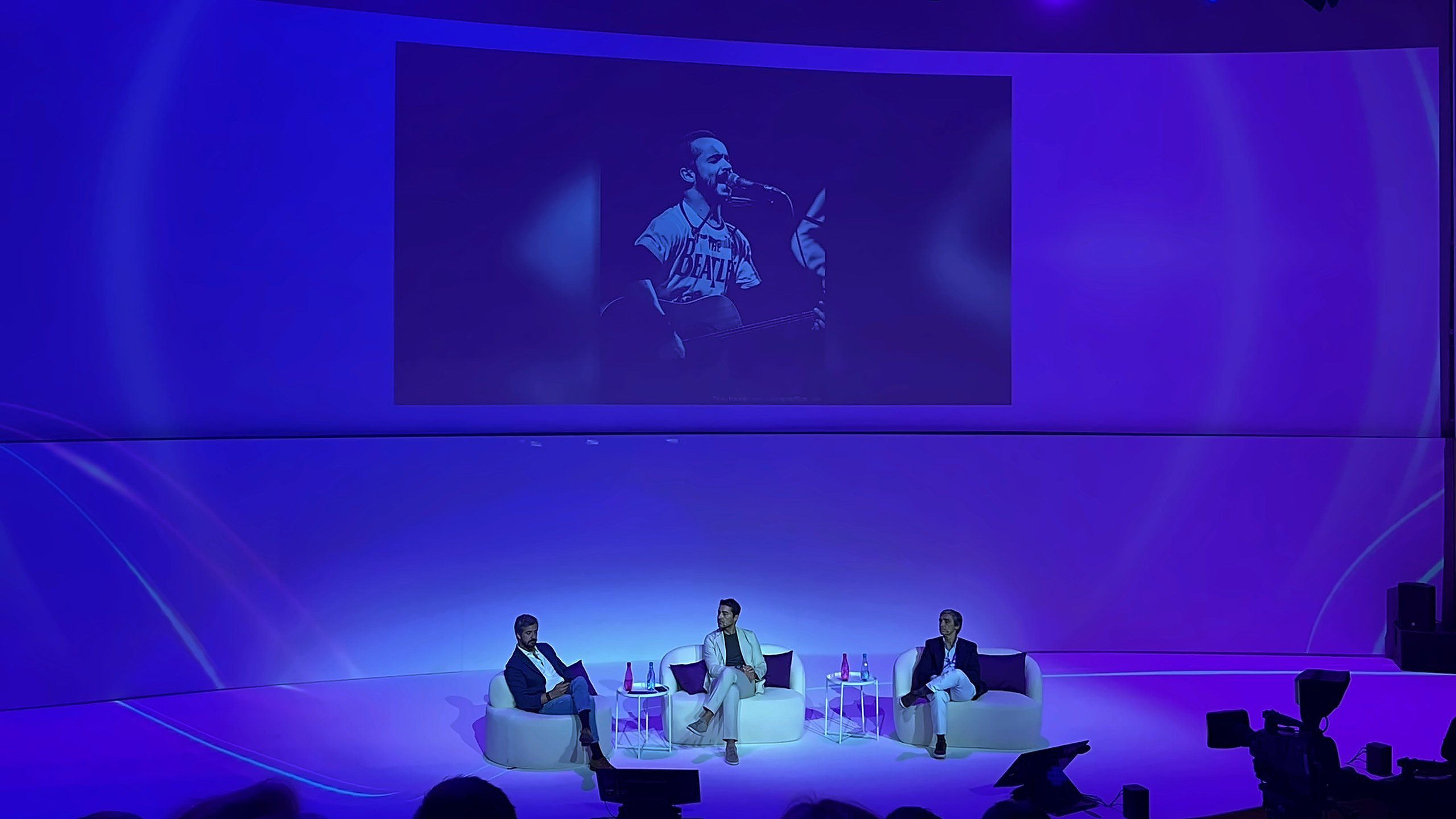
A neuroscientist, an actor and a corporate client joined VOQIN’ Partner Miguel Assis to argue that emotion decides what audiences notice and remember. The panel then ended with a moment nobody in the room had planned on.
Estoril, 2026
This year’s REINVENT the event, Portugal’s largest gathering of events professionals, had “Competing for Attention” as its theme. VOQIN’ answered it with a provocation of its own: without emotion, there is no attention.
“We have never had so many tools to win someone’s attention: more technology, more content, more data, more channels,” Miguel Assis told the audience at the Estoril Congress Centre. “And yet it has never seemed so hard to get someone to simply stop, look and stay with us.”
At VOQIN’, he explained, every project starts with a different question. It isn’t what do we want people to do? but what do we want people to feel? That question, and the agency’s work with neuroscience, led to VOQIN’s Emotional Thinking methodology.
To test the idea, Miguel brought three very different perspectives to the stage: neuroscientist Tiago Reis Marques, who joined through pre-recorded answers from Miami; actor and presenter Ricardo Pereira; and Rodrigo de Sousa Teixeira, Sales Manager Virtual Demand Center EMEA at Cisco, speaking for the companies that invest in corporate events and need them to deliver.
The Science: no relevance, no attention
Tiago Reis Marques started by adjusting the panel’s title. The brain, he explained, runs two attention systems. One is voluntary. The other is automatic and is set off by movement, a loud sound or a face. Behind both, a “salience network” keeps asking one thing: does this matter to me?
“I would say that without relevance there is no attention,” he said. “Emotion is the fastest and most powerful way the brain has to signal that relevance.”
He went on to describe the brain as a prediction machine. When the world behaves as expected, it saves energy and slips into autopilot: the “default mode network” that lets us drive the same route to work and remember none of it. Emotion breaks that autopilot with surprise, laughter, discomfort or a question that feels personal. “Your job,” he told the event professionals, “is to give the brain a reason to interrupt that circuit.”
His most practical advice was about memory. Emotional memories are vivid but narrow. Someone held at gunpoint remembers the gun, not the face. “If the emotional moment is the gun, your message has to be the hand holding it,” he said. “Emotion is the packaging the brain keeps, and the message has to be inside the package.” Get this wrong and you get what advertisers call the vampire effect: everyone remembers the ad and nobody remembers the brand.
The Stage: audiences want truth
Ricardo Pereira brought the view of someone who earns an audience’s attention for a living. “An audience can tell when you’re manufacturing an emotion,” he said. “People who come to an auditorium want truth. You capture an audience with truth.”
He described how his own industry is adapting to the way people now consume content: vertical formats made only for phones, subtitles so stories work without sound, shorter and more agile storytelling. The principle hasn’t changed, though. “What the world needs today is real experiences.” No production budget, he added, can rescue a weak script.
The Client: emotion is what we remember
Rodrigo de Sousa Teixeira, was invited to “spoil the theory”. He ended up backing it with one of the most striking stories of the morning.
Cisco’s annual sales conference brings together 20,000 to 25,000 people in Las Vegas for a week packed with AI, cybersecurity and technical content. The one thing kept secret is the closing speaker. Two years ago it was musician Jon Batiste. He had a piano lowered from the ceiling and asked 22,000 people to close their eyes while he played a song written for his wife during her battle with cancer.
“When the lights came back on, there were tears in the eyes of maybe 17,000 people,” Rodrigo recalled. “That was the emotion that stayed. And it became the benchmark for every event since.”
As a buyer of events, his message to agencies was clear. “The standard model of a speaker walking from one side of the stage to the other with 20 slides behind him is, for me, dead,” he said. “The croquete is over, the free giveaways are over. We need to be disruptive.” He cited a small, bold brand experience for 20 or 30 car-dealership clients in which the brand invited its own customers to roast it. It lasted two hours, and it stayed with him longer than many larger and more expensive productions.
Doing less better
Miguel then put a further challenge to the panel: what if the problem isn’t a lack of attention but too many things that don’t deserve it? More content, more speakers, more LEDs, more activations. Should we do less, and do it better?
Tiago’s closing recommendations pointed the same way. The brain doesn’t store an event like a film. It keeps the peaks and the ending, and compresses or discards the rest. His advice to anyone designing an experience:
- Choose two or three moments that are truly relevant, new and memorable.
- Break the expectation: if people walk in knowing what will happen, interrupt it.
- Engage more than one sense: the more senses involved, the better.
- Tie the message to the experience, inside it rather than beside it.
- Make the ending strong, because the final moment is the one people reliably remember.
A final moment, felt rather than explained
At the start of the session, Miguel had apologised for reading more from the teleprompter than usual and promised the audience they would understand why by the end.
When he was preparing the panel, he didn’t want it to finish with words alone. He had invited a friend, the musician Tomás Anahory, to compose an original song for the occasion and perform it live, showing through music what the panel had spent forty minutes trying to explain.
“Sadly, on 9 October, Tomás left us,” Miguel told the room.
Tomás could not be there in person, but he had finished the song. Miguel asked the audience to listen to it together. It was a piece about swipes, scrolls and the fight for attention, about memory, light, sound and friendship, and about the emotion that stays. “Today we talked about attention, emotion and memory,” he said. “But some things don’t need explaining. Some people, even after they are gone, keep making us feel.”
The song ended and the auditorium stood to applaud. The panel’s argument had been made in the most direct way possible.
“Without emotion there is no attention,” Miguel said in closing. “And there are emotions that stay in our memory forever.”


